

Singapore estates & satellite towns - Showcasing Toa Payoh Central
Written by Jane Tay
Photos by Tara Strunk
Singapore’s Local Housing Scene
Singapore houses the majority of its population in public housing built by the Housing & Development Board, HDB. Public housing consists of high-rise and low-rise concrete flats of various configurations and sizes. The first flats were built in the 1960s at Toa Payoh, Queenstown, and Marine Parade. As great numbers of people moved out of makeshift squatter quarters, fishing settlements, and multi-generation family huts in villages called “kampungs,” the demand for public housing quickly outgrew the supply. As a result, the housing board began to plan and clear more land to build new flats. All the new areas of housing development are known as satellite towns today. Singapore has 3 estates and 23 satellite towns. Apparently, the larger quantity of flats and the availability of useful amenities and necessary services in the community help define an estate. Thus, the smaller satellite towns as we know them, are all smaller “refined” versions of the original 3 housing estates.
Toa Payoh’s Pioneer History
Toa Payoh was the first public housing estate planned and built completely by the HDB. Before the construction of housing board flats, Toa Payoh consisted of Malay and Chinese villages called “kampongs.” There were also plenty of illegal squatters, farmland for gambier and pepper, small rural businesses, pig farms, burial grounds, and large quantities of forests and marshland. The forests dominated the high elevations while marshland ruled low-lying grounds.
In fact, it was because there was so much marshland that early Malay and Chinese settlers decided to call their new abode “Toa Payoh.” The name reflects the original landscape of the district. “Toa” means “huge” or “large” in Hokkien or Teochew while “Payoh’ is derived from “Paya” which means marshland or quagmire in the Malay language. Prior to clearance and development, Toa Payoh consisted of high elevations of forests with low-lying grounds of marshland. The marshland was fed by waterways such as the Kallang and Whampoa rivers.
In 1964, construction of the first housing board flats at Toa Payoh started. By June, 1966, the first tenants started to move into 840 one-room studio flats at Lorong 6. “Lorong” is Malay for “street.”

The HDB uses a naming convention to classify the size of a flat. For instance, a one-room flat consists of a common area which is defined as the living room with a kitchen. Thus, a two-room flat consists of one bedroom with a common area. Similarly, a three-room flat consists of two bedrooms with a common area, and so forth.

The HDB’s goal in the 1960s was to build around 30,000 flats in Toa Payoh to provide housing for around
250,000 people. The housing plans included construction of 480 shops and amenities such as schools, wet markets, grocery shops, clinics, cinemas, Community Centres, hawker food halls, and inter-denominational places of worship. Toa Payoh was constructed to serve as a model for the future construction of satellite towns.
Amenities & Services at Toa Payoh
Toa Payoh was built around the “Neighbourhood Principle” where neighbourhoods are

grouped around a town centre for easy access to amenities and services. A transport network was designed and implemented using a ring road with offshoot tributaries to facilitate easier travel between neighbourhoods and the town centre.
In 1973, Toa Payoh was selected as the Games Village for the seventh South-East Asian Peninsula Gomes, later renamed in 1977 as the South-East Asian Games. 1560 athletes and officials from neighbour nations were housed in four 25-storey towers built for the games. After the games ended, the towers were sold to the HDB flat buyers. The Games Secretariat building which coordinated the implementation of the games was converted into the Toa Payoh Public Library, as it is known today.
Today, Toa Payoh has just about every amenity and service you may imagine, all within a short stroll of the Integrated train station, bus interchange and HDB Hub. Once you get out of the turnstiles at the train station, take the elevator or one of two sets of escalators found at the far right or far left of the main doors to the ground floor. You are now in Toa Payoh Central.
Toa Payoh Central is a really pleasant neighbourhood to explore. The following is a sampling of amenities and services you may wish to visit when you call in at Toa Payoh
1. HDB Hub
2. Toa Payoh Library
3. Places of worship
4. Community Centres
5. Playgrounds, nursery schools & enrichment schools
6. Cafes, eating houses, and restaurants
7. Retail shops
1. HDB Hub
The HDB Hub is next door to the train station. It is the headquarters of the Housing & Development Board or HDB, the government body responsible for planning and building public housing in Singapore.
Singaporeans and married permanent residents may apply to buy or rent a new flat from the HDB at subsidised rates. The prices of the new flats are a fraction of the price of a similar sized flat built by private developers. For example, a brand new “2-Room” flat with a bedroom, small kitchen and hall that faces the ocean at Punggol may cost less than two hundred thousand dollars to buy. A similar sized private condo would easily cost two million dollars to buy. The HDB Hub has a show flat gallery of 2, 3, 4, & 5 Room flats at Level 3 of Biz 4 at 470 Toa Payoh Lorong 6. The gallery is open Monday to Saturday from 8.30 am to 5 pm.
2. Toa Payoh Library
Toa Payoh has a good-sized library of books, newspapers, and multimedia products.
The library is a short stroll from the train station. Take the escalator on the far right of the main doors to the ground floor, cross the road to block 183 and walk to the other end where there is a local eating house. The library is diagonally opposite at 6 Toa Payoh Central. It is open 10 am to 9 pm daily.
3. Places of worship
Toa Payoh Central houses Church of the Risen Christ, a Catholic church that is home to a world-renown choir led by choirmaster Peter Low since the early 1970s.
Toa Payoh Methodist Church and Victory Family Centre are other churches in the vicinity.

Outside of Christianity, you will see the Lian Shan Shuang Lin Monastery in Toa Payoh. It is the oldest Buddhist monastery in Singapore. Also known historically as the Siong Lin Temple, it was founded in 1898 by Hokkien merchant and primary benefactor Low Kim Pong and Master Xian Hui.
Low’s generosity was the result of a prophetic dream whereby he t
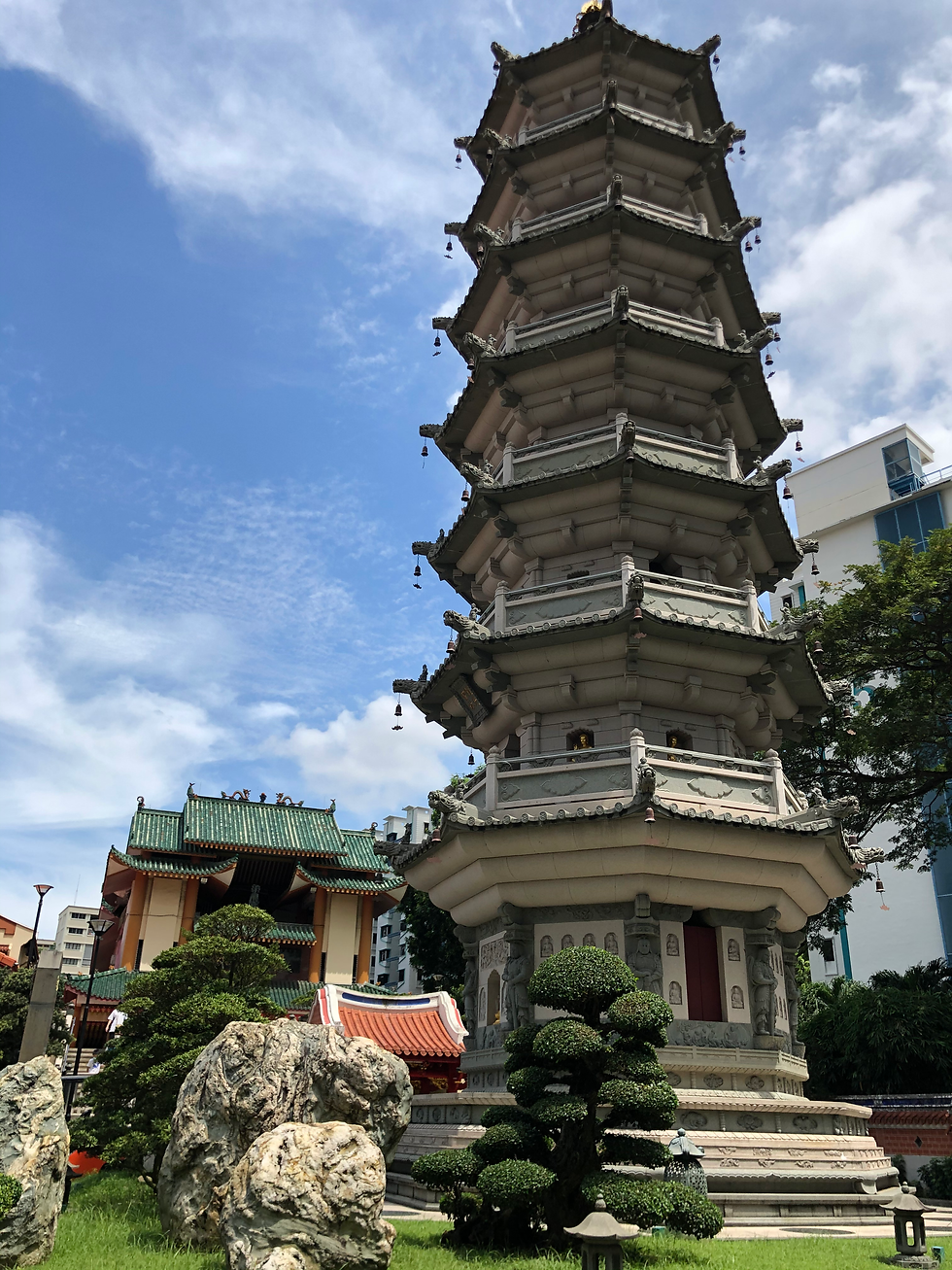
hen met with Buddhist clergy to offer 50 acres of land to build the monastery. The monastery as we know it today was completed in 1909.
The name “Lian Shan” is derived from the lotus mountain terrain while “Shuang Lin” denotes the twin sala trees where Buddhists say the Shakyamuni Buddha transitioned into nirvana.
Lian Shan Shuang Lin Monastery is open daily from 8 am to 5 pm.
4. Community Centres
Toa Payoh has 3 Community Centres in Toa Payoh East, Toa Payoh Central, and Toa Payoh West. Each community centre offers regular and holiday courses and workshops for children and adults. The centres are open daily from 10 am to 6 pm.
5. Playgrounds, nursery schools & enrichment schools

The Chinese see the dragon as a symbol of good luck, longevity, prosperity and strength. As a result, you often see a dragon dance and a lion dance at auspicious events such as at Chinese New Year.
In 1979, a HDB designer started building 3 children’s playgrounds with a dragon theme in Toa Payoh. Each

consisted of a tunnel with steel rails that children would have to climb to get to the dragon’s head at the top of the slide. Children would then slide down into a sandy pit which enclosed the playground. Every playground was built with two child-size plastic seats shaped in animal form and attached to a coil stem to allow a child to bounce when seated on it. Today, only the first dragon playground at Lorong 6 retains its huge sandy pit. It is infamously known as the dragon’s

playground. The other two original playgrounds have been fitted with foam mats.
There is a huge selection of nursery schools and enrichment schools in Toa Payoh Central. A few of the schools are at Level 4 of the HDB Hub. You will also see them when you walk down the pedestrian mall pavement between the shophouses.
6. Cafes, food halls, and restaurants
Toa Payoh Central is a food haven for just about every discerning taste. Stroll around the HDB Hub at Lorong 6 or the shophouses nearby and you will see many cafes, hawker food halls, and restaurants.
KOUFU at Level 2 of the HDB Hub offers various delicious local favourites such as fishball noodles, chicken rice or wanton mee at good prices. Patrons may seat inside the air-conditioned food hall to savour their food or eat at the tables in the outdoor atrium outside KOUFU that opens to the entrances to the banks.
If you like spicy food, then you have to call at Thai Siam Square Mookata at Lorong 4, Toa Payoh Central. This is true Thai BBQ that will not break the bank. They are open late every day until 2 in the wee hours of the morning.
There are so many eateries with good food and great prices at Toa Payoh Central. You simply have to walk around to check them out for yourself.
7. Retail shops
There is something for everyone here.
Beauty product shops and pharmacies carry a wide selection of beauty products and over-the-counter medicines.
Do-it-yourself shops are plentiful, carrying everything from plates and bowls to electronic gadgets.
Thrift shops such as Cash Converters at block 192 allow you to buy good quality items at very good prices so you always save.
Furniture shops supply good quality items with good price tags also. Check out block 177 to see what they have to offer.
There are so many shops with great buys here that you have to visit for yourself!
Mural photo

This mural, created by CHIJ Secondary students at Blk 93 Toa Payoh Lorong 4, depicts
residents gathering to share stories and enjoy each other's company. The birds shown are all species found at the Bird Park.


